


The Last Signer
Thomas McKean
(1734-1817)
Governor of Delaware
Governor of Pennsylvania
Delegates to the Continental Congress
President of the United States in Congress Assembled
The Last Signer of the Declaration of Independence
Known As:
1781–1782 portrait by
Charles Willson Peale
(1741-1827)
† - Denotes a fellow Resident of
Laurel Hill Cemetery
Growing up, our history is factory-fed to us. The same information, packaged the same way, was fed to us through very concise paragraphs in a thick, hardback textbook. Being ever interested in history, and Philadelphia History in particular, I have found that those dehydrated paragraphs come to life if you simply add life to them.
In the years when I served as a tour guide stationed at Fort Mifflin, there was a test that was given to the tour guides who worked in the Historic District of Philadelphia. One of the questions asked was who is the most proud son of Philadelphia. The answer they were looking for was Benjamin Franklin. However, that is not true. Had they taken a closer, more accurate look, they would have known that Benjamin Franklin was not a son of Philadelphia. If anything, he was an adopted son. Franklin was born in Boston, only coming to Philadelphia as a runaway, taking himself from the poor young man eating rolls while walking up Market Street to the industrious, well-respected Philadelphia Icon he is known as today.
Let's talk about the most famous event that Benjamin Franklin was known for, signing the Declaration of Independence. The most famous depiction of this event, the one that is shown in every history textbook, is the 1818 oil painting Declaration of Independence by John Trumbull (1756–1843). It depicts the signers all in the same room signing the document on that fateful day of July 4, 1776. However, it is widely known now that Trumbull took liberties when it came to this scene. Those men were not all in the room on that day, and they did not all sign it on that day.
Declaration of Independence (1819), John Trumbull
Looking at the painting today, the man seated second from the right is a Delawarean, Thomas McKean. He did not sign the document on that day. As a matter of fact, he didn't sign it that month, or even that year. There is a very interesting story associated with this man. To tell his story, we have to go back quite a few years.
As we travel back through the years, there are some things we need to know about the time when we will begin our journey. We will be arriving in the New World, commonly referred to as British America. The people here have either themselves migrated or have ancestors who have come here from the Old World, referencing Asia, Africa, or Europe.
Most of the people we will encounter came here for the freedom to practice their chosen religion without persecution. After all, this Province was founded by William Penn (1644-1718) on the grounds of religious freedom. Some also came here for the opportunity to own the land they live on.
At this time, each colony is not seen as a smaller piece of a larger nation. Each colony is seen as a country all its own, and is often referred to as such. For instance, someone from Pennsylvania may say, "In my country of Pennsylvania, we enjoy greater liberty of conscience than many places in Europe."
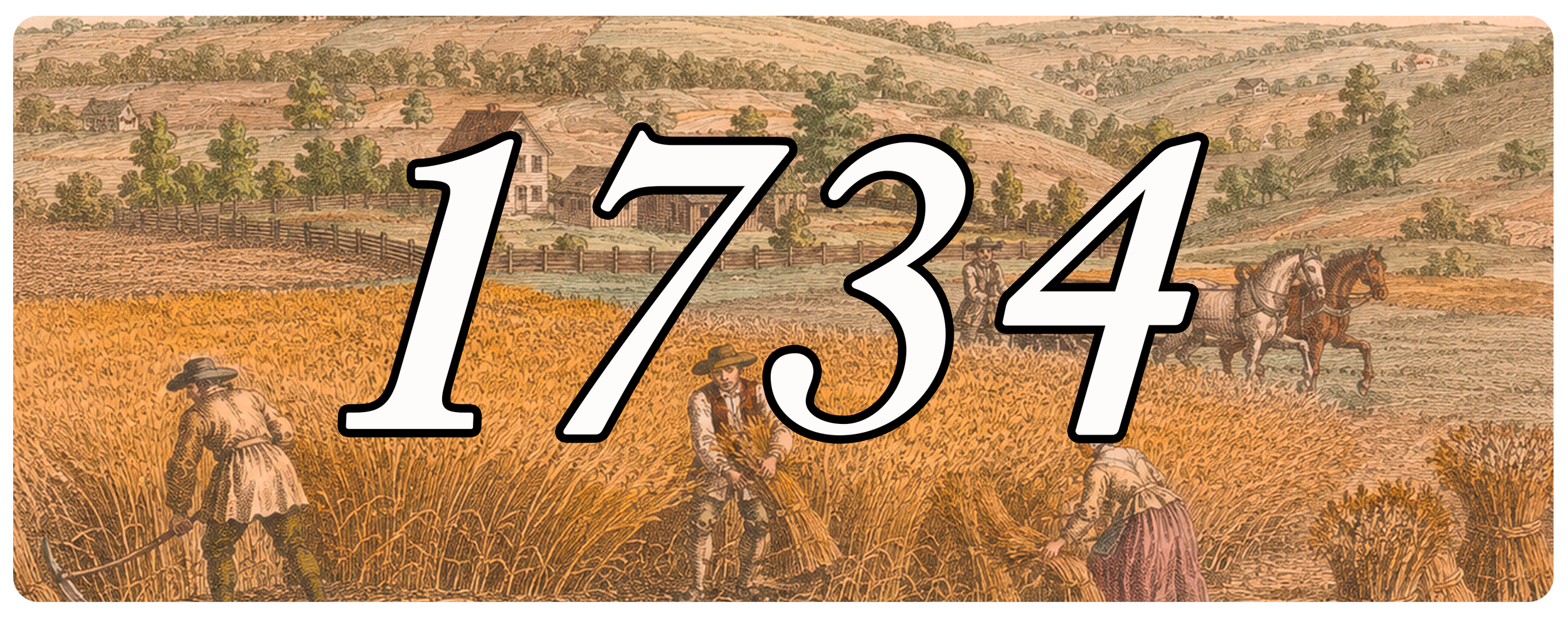
It is now the Spring season in the year 1734. It is in said country that we find ourselves in one of the most agriculturally rich counties in the region. This is Chester County. There are farms as far as the eye can see. The most commercially successful ones are those wheat farms. Flour from Chester County is exported throughout the 13 Colonies.
We are in exciting times indeed. Just last year, Mr. John Kay (1704-1779) invented the flying shuttle, making it much easier to weave broader fabrics. The talk is that this is the start of something called the Industrial Revolution.
Speaking of industries, the rum industry has been struggling since Parliament passed the Trade of Sugar Colonies Act last Christmas.
As we look around, We find ourselves on a farm located at what is now the intersection of Pennbrook Drive and New London Road in New London Township, Pennsylvania. Here we find the home of an innkeeper. We are forty miles from the site where they started building the new Pennsylvania State House. Known today as Independence Hall, its construction is only two years old on the day we begin our journey. It will not be completed for another nineteen years.
William McKean (1707-1769) and Letitia Finney McKean (1709-1742), were both born in Northern Ireland. They immigrated separately with their families to Chester County, Pennsylvania, by 1720. They are married in 1725, and William becomes an unsuccessful innkeeper in New London. Between 1732 and 1738, William and Letitia have four children.
Reverend Francis Alison
(1705-1779)
Their second son, Thomas McKean, is born on Friday, March 19, 1734. Early in his life, the family suffers a major loss when Letitia dies in August 1742. Young Thomas is only eight years old. Up until this point, he has been getting his education at home. Now, he and his older brother, Robert McKean (1732–1767), are sent to study under Reverend Francis Alison (1705-1779) at the New London Academy. Amongst their classmates is Charles Thompson (1729-1824†).
With the death of his wife taking a heavy toll on William, he closes his inn and marries Ann Logan ( -1751) in 1745. William moves to the Logan plantation with Ann, where he opens a tavern that he runs for the remainder of his life. During his career as a tabernero (or tavern owner), he dives into a life of alcohol. In his ever state of drunkenness, he is unable to care for his children.
While studying under Reverend Alison, young Thomas begins in-depth training in the courses being taught in the English language while learning enough German, Latin, and French to get by.
In 1750, at the age of sixteen, Thomas starts his law career when he begins studying under his cousin, David French Finney (1726-1806). He is admitted to the bar in Delaware in 1755 at the age of 21. He is then admitted to the bar of Pennsylvania just two years later.
Caesar Rodney
(1728–1784)
George Read
(1733-1798)
William Franklin
(1730-1813)
Thomas is barely twenty-four years old when he decides to perfect his legal studies at the Middle Temple in London. Thomas is admitted to the Middle Temple on May 9, 1758.
Upon his return to the American colonies, Royal Governor of New Jersey, William Franklin (1730-1813), son of colonial advocate hero Benjamin Franklin (1706-1790), grants Thomas McKean permission to practice law in all courts of his colony.
The three lower counties of Delaware have been under the government of the Province of Pennsylvania from 1632 to 1701, when they petitioned and were granted an independent colonial legislature as Delaware, despite the fact that both colonies share the same governor until 1776. For some time, Thomas serves as the leader of both colonies.
It is said that although Thomas is a master lawyer, committing details of his cases to memory, he lacks any sense of humor. Instead, he keeps his focus strictly fixed on the principles of the laws that he enforces. Believing that everyone should have the clear legal mind that he possesses, Thomas simply will not tolerate anyone who does not. This large man, who stands over six feet tall, will often lose his temper. Until, that is, it is time to draw up legal papers. His brief but clear statements are always grueling to refute. His own colleagues could rarely figure out his character.
In 1777, lawyer Edward Burd (1749-1833) writes:
“McKean behaves in the most violent and imperious manner. He is principally governed by his passions, an excellent quality in a Chief Justice.”
In 1781, Thomas Rodney (1744-1811) writes in his diary:
“…(a man of) great vanity, extremely fond of power and entirely governed by passions, ever pursuing the object present with warm enthusiastic zeal without much reflection or forecast.”
If this is the consent of his friends, I'd not want to know the thoughts of his enemies.
As we look at the broader scope of the political temperature of Delaware, we see that the people are divided into two political parties. Mostly made up of the Anglican, the major party is the Court Party. Strongest in the two southern counties of Kent and Sussex, they are in favor of reconciling with the British government and therefore work well with the colonial proprietary government.
Then we have the Country Party. Most members are Irish Presbyterian, sometimes referred to as Scotch-Irish. Based in New Castle, the northernmost county, they are in favor of breaking free from British rule. As a matter of fact, it was the British Penal Laws in Ireland that denied Catholics and Presbyterians the right to vote for members of parliament. Therefore, originating the slogan "no taxation without representation", which will be thrown around all throughout the impending American Revolution.
With his strong Irish descent, our man Thomas emerges as a leader in the Country Party. He becomes an ally with Kent County's Caesar Rodney (1728–1784), a merging leader in the Country Party, and a staunch antagonist of the Court Party. Together, they oppose Thomas' former classmate, George Read (1733-1798), who is rising as a leader in the Court Party.
In mid-December 1757, Thomas joins a specialized unit of the Pennsylvania militia known as foot soldiers under the command of Captain Richard Williams (1730–1812). Continually active throughout the Revolution, Thomas rises to the rank of colonel.
Early in his career, Thomas proves to have a masterful command of the law. Up-and-coming lawyers who studied under McKean have become prominent figures themselves. One such young man is future Lieutenant Colonel John Parke (1754-1789).
Prior to the war, Thomas concentrated on expanding his impact. Growing his practice, he makes sure to have the ability to practice in Pennsylvania and New Jersey in addition to already practicing in Delaware. By winning seats in important offices one after another, he establishes a reputation for honesty, insight on important issues, and the ability to have an influential impact much farther than his home in Delaware. So impressed with Thomas, the College of Philadelphia awards him an honorary Master of Arts degree in 1763.
Thomas is proud of all that he has accomplished. He believes that his swift success has brought on substantial jealousy “not only among the Juniors but also … some of the seniors of the Profession.”
He develops an addiction to office titles. He was elected to the Delaware General Assembly in October 1762, where he and Caesar Rodney revise laws passed prior to 1752. He serves the General Assembly for a total of seventeen years, despite not living in Delaware for six of those years.
In 1765, Thomas McKean is chosen to represent the Lower Counties of Delaware in the Stamp Act Congress, alongside his father-in-law, Colonel Joseph Borden (1719-1791), who represents New Jersey.
The Estate of Colonel Joseph Borden
Let's take a brief pause from politics here to discuss the Borden family. Thomas marries Mary Borden (1744-1773) on July 21, 1763, in Monmouth County, New Jersey. Her grandfather, Joseph Borden (1687–1765), was a merchant who established a stagecoach and boat service between Philadelphia and New York. As his business thrived, a community emerged that to this day bears his name. That's right, he is the namesake of Bordentown, NJ.
Mary's sister, Ann Borden (1747-1827), marries fellow Signer of the Declaration, Francis Hopkinson (1737-1791).
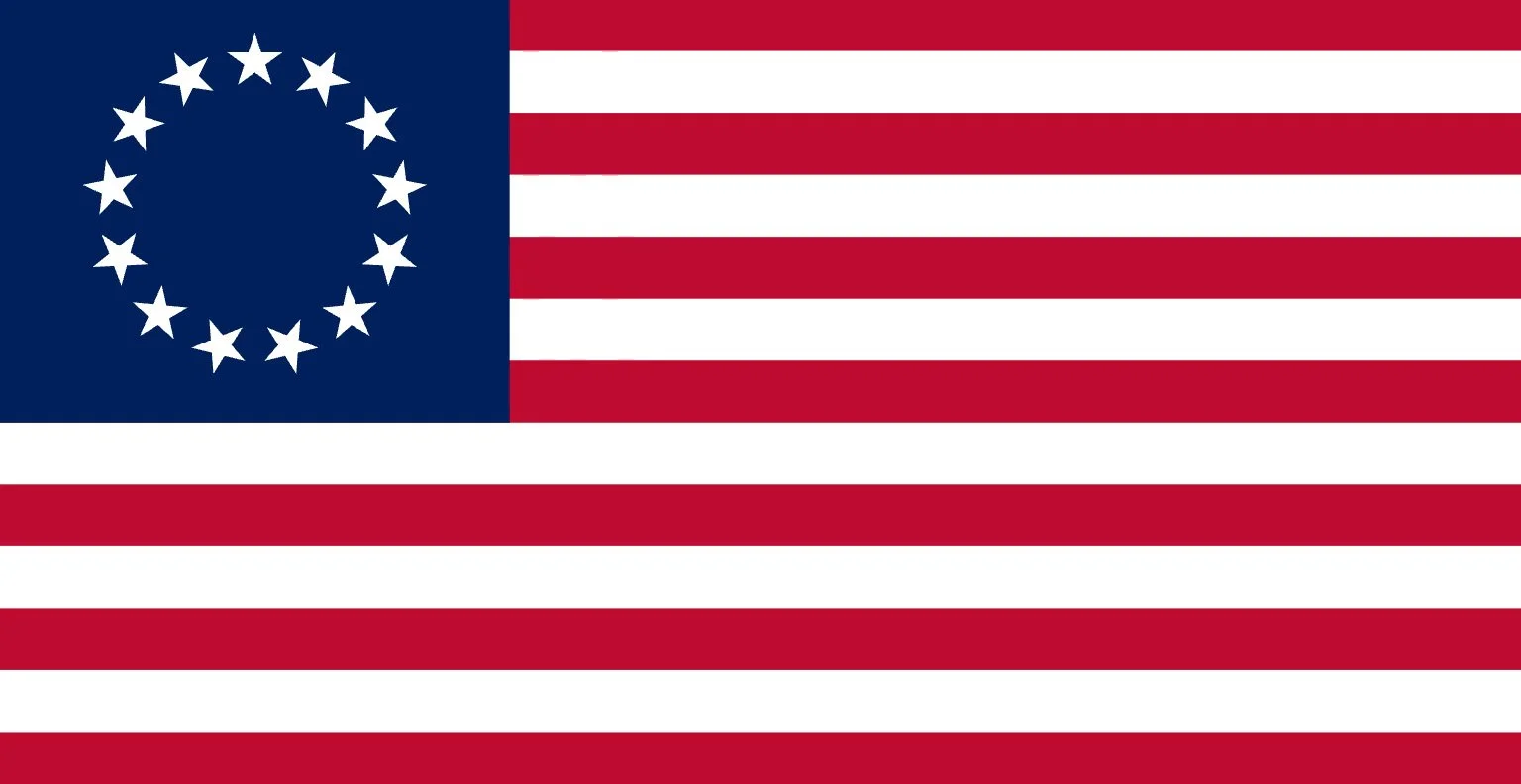
It is Francis Hopkinson who designs the first 13-star and 13-striped layout of the first adopted national flag. His original flag had 13 white 6-pointed stars spread out in a diagonal formation over a field of blue.
When presented to Congress, George Ross (1730–1779) knew of a seamstress in Philadelphia. His nephew, John Ross (1752–1776), and his wife, Betsy Ross (1752-1836), run an upholstery business from their home at 239 Arch Street. When George Ross, General George Washington (1732-1799), and Robert Morris (1734-1806), met with Betsy, she explained to the men how a 5-pointed star was much easier to cut and sew.
Ok, let's get back to the McKeans.
Thomas McKean and Mary Borden have a total of six children, five of whom survive to adulthood. Two weeks after the birth of their sixth child, Mary dies suddenly.
Thomas is not lonely for long. The following year, on September 7, 1774, Thomas marries, Sarah Armitage (1756-1820). The groom is 40 years old, the bride is 18. They have four children together.
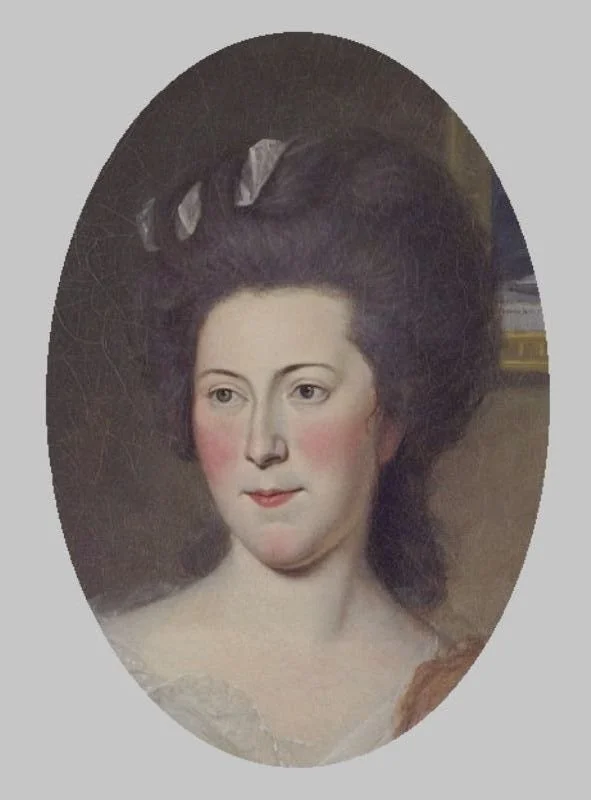
Sarah Armitage
(1756-1820)
Now, back to Thomas's career.
McKean is elected unanimously to Speaker of the House of Assembly of Delaware. He is then elected to be a delegate in the First Continental Congress in 1774. Thomas then moves to the northeast corner of 3rd and Pine Streets in Philadelphia. This allows him not only to be closer to Congress, but it also allows him to practice law in Philadelphia. He will represent Delaware in the First and Second Continental Congress, as well as the Confederation Congress, through 1783.
On December 16, 1773, in protest of the newly passed Stamp Act, the Sons of Liberty intercept a shipment of imported tea, dumping 342 chests into Boston Harbor. The royal reaction comes in March 1774, when the Boston Port Bill is passed, closing Boston's port. The colonies send aid to all those who are suffering as a result. The letter from Delaware is signed by the "Big Three" of Delaware: George Read, Caesar Rodney, and Thomas McKean. Soon after, it is time for the Colonists to decide who they are in favor of. Those who side with the Whigs, also known as Patriots, want their independence. Those who side with Tories, also known as Loyalists, remain true to Great Britain.
The rift between England and its colonies is increasing. The pleas Congress has made to King George III, trying to come to an agreement, are falling on deaf ears. When patience wears out on May 15, 1776, the Fifth Virginia Convention unanimously passes a resolution for its delegates in the Continental Congress to propose that the United Colonies declare their freedom and become independent states. The die is now cast. Despite some members of Congress being opposed to this act, McKean, on the other hand, shows his support for it when he states, “that the step must be taken, or liberty, property, and life lost.”
On June 6th, it is unanimously agreed to support the declaration of May 15th by the 4th battalion serving under Colonel McKean.
At Carpenter's Hall on June 18th, Thomas is elected president of the convention of delegates. On June 24th, together, along with Dr. Benjamin Rush (1746-1813) and Colonel James Smith (1719-1806), they prepare a declaration that stated “declaring the united colonies free and independent states”. It is presented the following day to Congress.
Originally scheduled for June 10th, but postponed, Congress continues to debate the resolution before the body. The resolution reported from the Committee of the Whole ultamately is agreed upon after the official document is drawn by Thomas Jefferson (1743-1826) on July 2, 1776 that “Resolved, that these United Colonies are, and of right ought to be, free and independent States, that they are absolved from all allegiance to the British Crown, and that all political connection between them and the State of Great Britain is, and ought to be, totally dissolved.”
The delegates in attendance representing Delaware are Thomas McKean and George Read. The Committee takes a vote on the resolution. While Thomas McKean votes for it, George Read votes against it. The votes are being taken by the States. Every state votes in favor of the resolution except Pennsylvania and Delaware. With a split decision from Delaware, they are in danger of being lost. It had already been decided that all states must agree, and the vote had to be unanimous.
Without hesitation, Thomas McKean sent a dispatch to Delaware, requesting Caesar Rodney's assistance and presence. Rodney high tails it up to Philadelphia as fast as he can. In his boots and spurs, he arrives at the Pennsylvania State House just in time to cast his vote in favor, securing Delaware's vote. With that, the decision to break from the tight fist of Britain's rule is unanimous.
It is in Congress, July 4, 1776, that the committee reports their Declaration of Independence.
"We hold these truths to be self-evident, that all men are created equal, that they are endowed by their Creator with certain unalienable Rights, that among these are Life, Liberty, and the pursuit of Happiness."
It is Colonel John Trumbull (1756-1843) who romanticizes the event with his 1818 painting, Declaration of Independence, which cements the occasion for future generations. The painting depicts 42 of the 56 signers in the room where it happened, at the Pennsylvania State House. The majority of the delegates are assembled in a half circle around the desk. John Adams (1735-1826), Roger Sherman (1721-1793), Robert R. Livingston (1746-1813), Thomas Jefferson (1743-1826), and Benjamin Franklin (1706-1790) stand in front of the desk while Charles Thompson (1729-1824) stands next to a seated John Hancock (1737-1793) behind the desk. The painting is forever associated with the date July 4, 1776.
Despite the beauty of this masterpiece, Trumbull took artistic liberties with his depiction. As researchers often find, what we are taught in schools as children is not necessarily true to actual history. Facts taught to school children are often a brief glance, often embellished, with flaws that are not considered acceptable by modern standards, and are omitted from textbooks, leaving gaps that are filled in with misconstrued myths that live on in those who have no interest in taking a deeper look.
While serving as a beautiful stepping-stone into the monumental event, the Signers of the Declaration of Independence most certainly do not sign the document together. They don't even sign on the same day, the same month, or even, in some cases, the same year. Journalist William Duane (1760-1835†) writes:
“Mr. Jefferson was so clearly wrong in stating that Pennsylvania's vote for Independence was secured by the appearance of new members on the fourth of July, that we have a right to suspect him in error in other points."
In an article titled The Declaration of Independence, the Statements of Thomas McKean and Thomas Jefferson Compared, an author whose name is lost in history wrote:
“Mr. Jefferson, at the time he wrote his autobiography, was very old; and we all know that the memory is the first of the mental faculties to show signs of decay. He confused what was done in Congress in August, with what was done in July. … His account cannot be compared with the clear and positive statements of Governor Thomas McKean.”
The truth of the matter is that the only signatures needed to ratify the document are John Hancock, who serves as the congressional president, and Charles Thompson, who serves as the congressional secretary. After John Hancock makes his most famous of marks, he states:
“There! John Bull can read my name without spectacles and may double the reward of £500 for my head. That is my defiance”.
John Bull serves as the British mythical figure representing Great Britain. He is the counterpart to our own Uncle Sam. Hancock then turns to Benjamin Franklin and states:
"There must be no pulling different ways. We must all hang together,"
To which Franklin replies:
"We must, indeed, all hang together, or most assuredly we shall all hang separately".
So, when was this document signed by all 52 signers? The only thing that is certain is that it was not until August of 1777 that all the signers who appear on the document today had signed it.
Ok, now let's get back to Congress. It's on September 9, 1776, that the Second Continental Congress officially desposes the name "United Colonies of North America". Henceforth, we shall be known as the "United States of America."
In spite of his strong support of this ratification, before he could sign the document, Colonel Thomas McKean takes an immediate leave of absence to support General Washington and his Continental Army on the battlefield. Colonel McKean and his troops march to meet him in Perth Amboy, New Jersey. His service as Speaker of the Delaware House of Assembly ends with the end of 1776. Upon his return, Thomas McKean made it known that he was present and voted on that hot day of July 4, 1776. He explains that while members of Congress were signing their names to the document on August 2, 1776, his military duty called for his presence, and he could not be in attendance. Congress reports “Resolved, That the said Hon. Thomas McKean be allowed to affix his signature to the aforesaid Declaration.” Colonel McKean signed his name sometime after January 17, 1777.
At the bottom of the fourth column of names, you will find the signature of Thomas McKean, making him The Last Signer of the Declaration of Independence. First printings and distributions before he could sign are early and rare copies of the idolized document. When looking at a copy today, the way to determine when it was printed is to simply look for McKean's name.
It's July 28, 1777, when Thomas was elected Chief Justice in the Pennsylvania Supreme Court, a role he will serve for 22 years.
In a letter dated September 22, 1813, to his old friend Caesar Rodney, Thomas writes:
“When the associators were discharged, I returned to Philadelphia, took my seat in Congress, and signed the declaration on parchment. Two days after I went to Newcastle, joined the Convention for forming a constitution for the future government of the State of Delaware (having been elected a member for Newcastle County), which I wrote in a tavern without a book or any assistance."
With few, if any, state constitutions to use as an example. Thomas's constitution is original work. To write this while in a tavern means he has to rely on his critical judgment, quick discernment, substantial memory, and deep knowledge of both politics and the law.
Now, as Chief Justice in the Pennsylvania Supreme Court, he often rules on capital cases of treason. In addition to being a stern character, his appearance further reinforces this image. While sitting on the bench, he is dressed in a scarlet gown, topped with his bright white wig under his enormous cocked hat. His actions complete his reputation.
One instance when a mob forms outside the Pennsylvania State House, Thomas sends for the sheriff with orders to control the people. When the sheriff and his posse prove to be ineffective, Thomas asked him:
"Then, sir, why don't you summon me?"
Shocked at the question, the sheriff replies
"I do summon you, sir."
Then, without hesitation, the Chief Justice of the Pennsylvania Supreme Court, dressed in full courtroom attire, ascends onto the mob. Grabbing two instigators by their throats, he disperses the mob himself.
As the Chief Justice of Pennsylvania, Judge Thomas McKean is elected President of the State of Delaware on September 22, 1777. He is now seen as a double threat through the British lens. Thomas only remains the president of Delaware long enough for his old friend, political rival George Read, to rise and take the position, and leaves that office on October 20, 1777.
Meanwhile, Philadelphia is in severe trouble.
On September 26, 1777, British forces invade and capture our beloved capital, forcing the Continental Congress to move its affairs to York, Pennsylvania.
Thomas serves as a committee member to draw up the Articles of Confederation, finalized on November 15, 1777. However, it is not until Congress is back in Philadelphia that it is ratified on March 1, 1781. Thomas signs the document as a representative of Delaware. Maryland becomes the final state to sign the document.
Samuel Huntington
(1731–1796)
After the articles are signed and ratified, the President of the Continental Congress, Samuel Huntington (1731–1796), is the first to hold the title "President of the United States in Congress Assembled".
On their way to Yorktown, which becomes the final official battle of the American Revolution, the Continental Army passes through Philadelphia on September 2, 1781. Right behind them, our French allies pass through on September 3rd and 4th. All are reviewed by the President of Vonfress, Thomas McKean, dressed in black velvet, with a sword at his side and a covered head. Both Commander-in-Chief of the Continental Army, General Washington, and Lieutenant General in the French Army, Jean-Baptiste Donatien de Vimeur, comte de Rochambeau (1725-1807), have their heads uncovered.
Although he does not participate in the Constitutional Convention, Thomas McKean works with James Wilson (1742–1798) to convince Pennsylvania to ratify the Constitution. In 1789, Thomas works with delegates to revise the Pennsylvania Constitution, aligning it with the United States Constitution.
When Irish-American publisher, Mathew Carey (1760–1839), reorganizes the Hibernian Society for the Relief of Immigrants from Ireland at the beginning of April 1790, Thomas is elected the organization's first president.
Later in the same month, the man commonly known as The First American, Benjamin Franklin, passes away. His funeral takes place on Wednesday, April 21, 1790. An estimated twenty thousand people flood the streets of Philadelphia to mourn. The procession begins at the Pennsylvania State House. The pallbearers are Thomas McKean, the colonial and post-revolutionary mayor of Philadelphia, Samuel Powel (1738-1793), American statesman and wealthy merchant, William Bingham (1752-1804), American merchant, banker, and politician, Thomas Willing (1731-1821), American merchant, soldier, and Govorner of Pennsylvania, Thomas Mifflin (1744-1800), astronomer and inventor, David Rittenhouse (1732-1796†). They carry the great man to his final resting place at Christ Church Burial Ground.
Thomas McKean is elected Governor of Pennsylvania for the first time in 1799, and is reelected twice more. It's during the third term that political rivals try to impeach him. They are unsuccessful.
During his term in office, Thomas begins serving the University of the State of Pennsylvania, sitting as the President of the Board of Trustees.
In 1793, in his role as Chief Justice, he makes a ruling that establishes a mandate that the Court can stop and nullify those laws that were decided to be against the State Constitution.
Because he already served as president under the Articles of Confederation, in 1804, he turns down a Vice President nomination in the Thomas Jefferson administration. The role is filled by New York Senator George Clinton (1739-1812).
It's 1808. Thomas is now 74 and decides to retire from the many positions he holds in favor of having time to enjoy life with his wife, Sarah. In his retirement, he manages the wealth he has built. He spends time reading and writing. On occasion, he will engage in political discussions. Thomas remains a strong presence and a prominent figure from his home at the corner of 3rd and Pine Streets.
When the War of 1812 breaks out, Thomas leads a group of citizens to help organize the defenses of Philadelphia.
Thomas McKean passes away on Tuesday, June 24, 1817. He is buried at the First Presbyterian Church on the corner of High Street and Bank Street. By 1822, the First Presbyterian Church is facing unsafe conditions. It is now abandoned and demolished. As time went on, High Street was known for the vendors that lined the middle of the street, and was officially renamed in 1854 to Market Street.
In the 1830's, a man decided to relocate his daughter's grave from a place that was dreadful to a place that would be welcoming. John Jay Smith (1798-1881†), Benjamin Wood Richards (1797-1851†), Nathan Dunn (1782-1844), William Strickland (1788-1854), and Frederick Brown (1796-1864† ) employed architect John Notman (1810-1865†) to design a garden cemetery outside of Philadelphia. In 1836, they opened Laurel Hill Cemetery.
A year later, the nation is hit with an economic depression known as the Panic of 1837. Desperate to stay afloat, the managers of Laurel Hill Cemetery come up with a marketing ploy that is a three-fold plan. They want to relocate celebrity corpses. First, having famous graves in their cemetery will elevate their status as a place where the elite rest in peace. Second, they know that this will attract common folk who wish to be buried in the presence of the elite. Third, they know that having the famous graves in their cemetery will attract visitors who wish to see the final resting place of these famous Philadelphians. Not only does this plan work, but to this day, over 25,000 visitors walk the sacred grounds each year.
Thomas McKean is seen as a hero of the American Revolution. He is relocated in December 1843 to Laurel Hill Cemetery, Section G, Plot 210-211, inside an enormous family vault. He rests there today not far from fellow Singer of the Declaration Charles Thompson (1729-1824†), as well as being surrounded by other famous residents, such as Ferdinand Hassler (1770-1843†), William Short (1759-1849†), Richard Rush (1780-1859†), and David Rittenhouse (1732-1796†).
The capstone reads:
McKEAN FAMILY VAULT.
Beneath…this marble…are the remains … of THOMAS McKEAN,
one of the Signers … of the … Declaration of Independence, … President of Congress in 1781, … Chief Justice … and … Governor …of the … State of Pennsylvania, Born, March 19, 1734, died, June 24, 1817.
And the DESCENDANTS of his … FAMILY, HIS LIFE AND CHARACTER
In the late 1950's, American composer Sherman Edwards (1919-1981), began working on a musical stage show based on the debates of the Continental Congress. On March 16, 1969, at the 46th Street Theater (now the Richard Rogers Theater), the musical 1776 debuted on Broadway.
Being so popular, 1776 is turned into a film version in 1972. Many of the Broadway stars return to reprise their roles for the film adaptation, including William Dainails (1927- ) as John Adams. If you are a child of the 1980's, you will remember Daniels's voice the moment you hear it. From 1982 until 1986, he lends his voice as the voice of K.I.T.T. in the television show Knight Rider. At the same time, he makes his on-screen presence as Dr. Mark Craig in the television show St. Elsewhere. However, William Dainails earns his respect among children when he plays the wise neighbor, teacher, and mentor, Mr. Feeny, on Boy Meets World.
Bruce MacKay (1919-1985) portrayed Thomas McKean in the original Broadway cast. McKean is distinguished from the other founding fathers by being presented with a thick Scottish accent. A trait that Ray Middleton (1907-1984) carries over to the silver screen. Actor Anthony Lawton (1967- ) portrayed Thomas McKean with the same thick Scottish accent in the Walnut Street Theater production. Despite all of them doing an excellent job, this is one historical inaccuracy. While it is true that he had Irish lineage, Thomas McKean was born in Chester County. He never had an accent.
Over the last several years, my family and I have held season memberships to The Walnut Street Theater. With my special interest in those who lived in this great city before us, it is often brought to my attention the times that these residents have frequently attended local stage productions at one of the many theaters that once dotted the streets of Philadelphia. It gives me a great sense of belonging to that world each time I take in a night of the performing arts. One of the most enlightening productions I have attended was the performance of Groucho: A Life in Revue. I had not known much about the Marx Brothers going in, but I left with a greater appreciation for their work. The moment that thrilled me the most was the inclusion that The Walnut Street Theater was responsible for launching The Marx Brothers' first stage show (I'll Say She Is) and catapulting them into world-renowned celebrities.
When the Walnut Street Theater announced that the final show of the 2025-2026 season would be 1776, I was so excited. I had never seen the film and didn't know what to expect. The last time I thought a musical about the American Revolution was a terrible idea, it turned out to be one of my favorite shows. In the Spring of 2026, I took my daughter, Savanna, and her boyfriend, Alex, to the Walnut Street Theater. We sat in our front-row seats with excited anticipation. I hung on every word. As they lowered the Signed Declaration of Independence from the rafters, it pushed the tears down my cheeks and cemented my pride in being a Philadelphian. This is where it all happened! It has been the best show I have seen there.
Sources:
1. Find a Grave
Website name: Find a Grave
Article Title: Thomas McKean Memorial
Author: Find a Grave Contributors
Website Title: Find a Grave
Publication Date: n.d.
Volume and Issue: n/a
Page Numbers: n/a
URL: https://www.findagrave.com/memorial/2676/thomas-mckean
2. FamilySearch
Website name: FamilySearch
Article Title: Thomas McKean Person Profile (LZSS-X3Y)
Author: FamilySearch Contributors
Website Title: FamilySearch Family Tree
Publication Date: n.d.
Volume and Issue: n/a
Page Numbers: n/a
URL: https://www.familysearch.org/en/tree/person/about/LZSS-X3Y
3. Wikipedia – Thomas McKean
Website name: Wikipedia
Article Title: Thomas McKean
Author: Wikipedia Contributors
Website Title: Wikipedia
Publication Date: last edited n.d.
Volume and Issue: n/a
Page Numbers: n/a
URL: https://en.wikipedia.org/wiki/Thomas_McKean
4. Wikipedia – Francis Alison
Website name: Wikipedia
Article Title: Francis Alison
Author: Wikipedia Contributors
Website Title: Wikipedia
Publication Date: last edited n.d.
Volume and Issue: n/a
Page Numbers: n/a
URL: https://en.wikipedia.org/wiki/Francis_Alison
5. Find a Grave – William McKean
Website name: Find a Grave
Article Title: William McKean Memorial
Author: Find a Grave Contributors
Website Title: Find a Grave
Publication Date: n.d.
Volume and Issue: n/a
Page Numbers: n/a
URL: https://www.findagrave.com/memorial/53256576/william-mckean
6. Internet Archive – Colonial Revolution Vol. 3
Website name: Internet Archive
Article Title: Colonial Revolution, Volume 3 (p. 1178)
Author: John W. Jordan (ed.)
Website Title: Internet Archive
Publication Date: n.d.
Volume and Issue: Vol. 3
Page Numbers: p. 1178
URL: https://archive.org/details/colonialrevolutiv3jord/page/1178/mode/2up
7. Wikipedia – Francis Hopkinson
Website name: Wikipedia
Article Title: Francis Hopkinson
Author: Wikipedia Contributors
Website Title: Wikipedia
Publication Date: last edited n.d.
Volume and Issue: n/a
Page Numbers: n/a
URL: https://en.wikipedia.org/wiki/Francis_Hopkinson
8. National Archives
Website name: National Archives
Article Title: Declaration of Independence Transcript
Author: National Archives
Website Title: archives.gov
Publication Date: n.d.
Volume and Issue: n/a
Page Numbers: n/a
URL: https://www.archives.gov/founding-docs/declaration-transcript
9. Wikimedia Commons
Website name: Wikimedia Commons
Article Title: Trumbull Declaration of Independence Image
Author: Wikimedia Contributors
Website Title: Wikimedia Commons
Publication Date: n.d.
Volume and Issue: n/a
Page Numbers: n/a
URL: https://upload.wikimedia.org/wikipedia/commons/5/56/KeyTrumbullsDeclarationofIndependence1.jpg
10. Founders Online – Franklin Papers
Website name: Founders Online
Article Title: Franklin Papers (01-22-02-0284)
Author: National Archives / Founders Online
Website Title: founders.archives.gov
Publication Date: n.d.
Volume and Issue: n/a
Page Numbers: document 01-22-02-0284
URL: https://founders.archives.gov/documents/Franklin/01-22-02-0284
11. DSDI 1776
Website name: DSDI 1776
Article Title: Thomas McKean Signer Profile
Author: DSDI1776 Editors
Website Title: dsdi1776.com
Publication Date: n.d.
URL: https://www.dsdi1776.com/signer/thomas-mckean/
12. National Governors Association
Website name: National Governors Association
Article Title: Thomas McKean Biography
Author: NGA Staff
Website Title: nga.org
Publication Date: n.d.
URL: https://www.nga.org/governor/thomas-mckean-3/
13. Founders Online – Jefferson Papers
Website name: Founders Online
Article Title: Jefferson Papers (03-19-02-0356-0002)
Author: National Archives / Founders Online
Website Title: founders.archives.gov
Publication Date: n.d.
URL: https://founders.archives.gov/documents/Jefferson/03-19-02-0356-0002
14. Wikipedia – Articles of Confederation
Website name: Wikipedia
Article Title: Articles of Confederation
Author: Wikipedia Contributors
Website Title: Wikipedia
Publication Date: last edited n.d.
URL: https://en.wikipedia.org/wiki/Articles_of_Confederation
15. History.com
Website name: History.com
Article Title: Benjamin Franklin Biography
Author: History.com Editors
Website Title: History.com
Publication Date: n.d.
URL: https://www.history.com/articles/benjamin-franklin
16. Encyclopaedia Britannica
Website name: Encyclopaedia Britannica
Article Title: John Hanson Biography
Author: Britannica Editors
Website Title: britannica.com
Publication Date: n.d.
URL: https://www.britannica.com/biography/John-Hanson
17. USHistory.org
Website name: USHistory.org
Article Title: Franklin’s Grave in Philadelphia
Author: Independence Hall Association
Website Title: ushistory.org
Publication Date: n.d.
URL: https://www.ushistory.org/franklin/philadelphia/grave.htm
18. Mathew Carey Info
Website name: Mathew Carey Info
Article Title: The Hibernian Society
Author: Site Editors
Website Title: mathewcarey.info
Publication Date: n.d.
URL: https://www.mathewcarey.info/life-legacy/transition-to-publisher-and-democratic-republican-1789-1796/the-hibernian-society/
19. Wikipedia – 1776 (Musical)
Website name: Wikipedia
Article Title: 1776 (musical)
Author: Wikipedia Contributors
Website Title: Wikipedia
Publication Date: last edited n.d.
URL: https://en.wikipedia.org/wiki/1776_(musical)
20. Internet Archive – Philadelphia Graveyards Book
Website name: Internet Archive
Article Title: Philadelphia Grave Yards and Cemeteries
Author: Thomas H. Keels
Website Title: Internet Archive
Publication Date: n.d.
URL: https://ia800106.us.archive.org/1/items/historyofchester00heat/historyofchester00heat.pdf
21. Walnut Street Theatre
Website name: Walnut Street Theatre
Article Title: Groucho: A Life in Revue
Author: Walnut Street Theatre Staff
Website Title: walnutstreettheatre.org
Publication Date: n.d.
URL: https://www.walnutstreettheatre.org/season/show/groucho-a-life-in-revue
22. Philadelphia Reflections
Website name: Philadelphia Reflections
Article Title: Blog Post 1712
Author: Site Editor
Website Title: philadelphia-reflections.com
Publication Date: n.d.
URL: https://www.philadelphia-reflections.com/blog/1712.htm